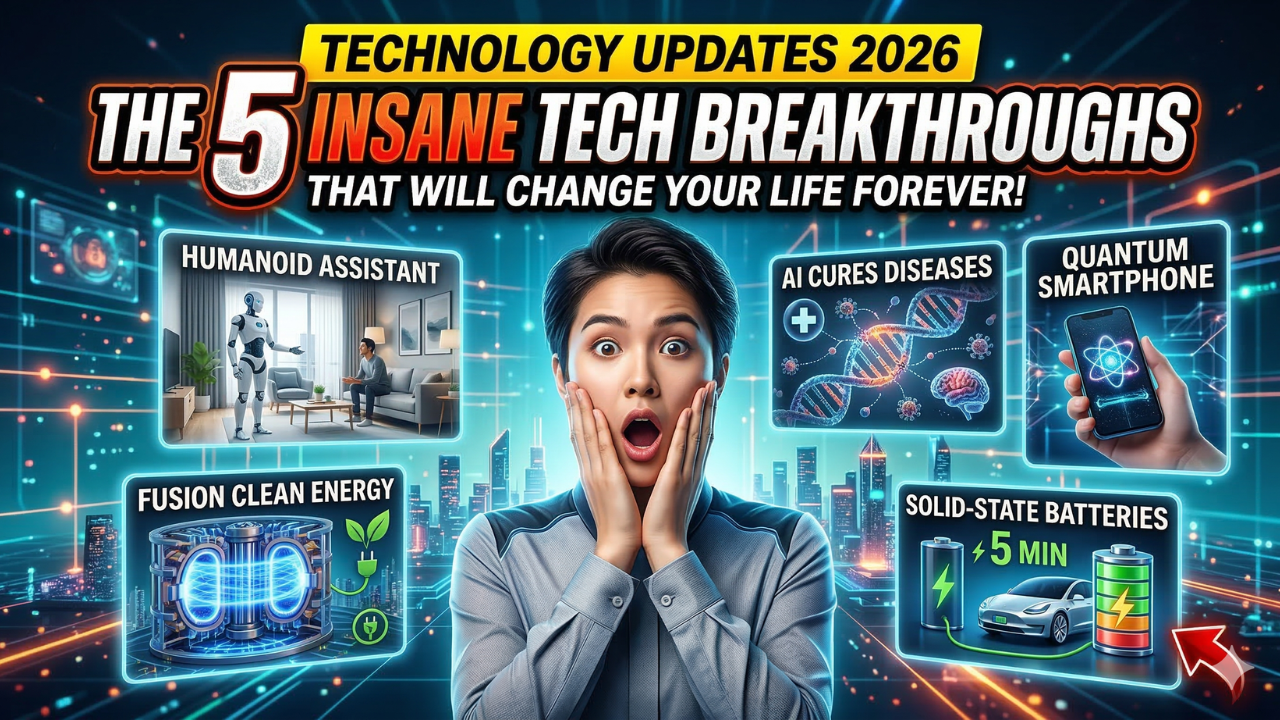
Technology Updates 2026: If you are just now getting comfortable with using basic AI chatbots to write your emails or summarize PDFs, hold onto your seat. The rapid advancements in technology are causing what was once considered “cutting-edge” twelve months ago to become outdated.
We have officially moved past the experimental phase of the digital revolution. In 2026, technology is no longer just a tool we use; it is an active, autonomous participant in our daily lives. From the death of the “dumb” smartphone to a massive shift in how we power our electric vehicles, staying informed is the only way to avoid being left behind.
If you want to know what is actually happening behind the closed doors of Silicon Valley and global research labs, here is your ultimate guide to the most shocking technology updates defining 2026.
1. The Rise of the “Silicon Workforce” (Agentic AI)
For the past couple of years, artificial intelligence has been largely conversational. You asked a question, and it gave you an answer. In 2026, we will have officially entered the era of agentic AI.
Instead of just talking to you, AI agents are now designed to do the work for you. We are witnessing the birth of the “Silicon Workforce.” You can now give an AI system a multi-step, complex goal—like “analyze my competitor’s pricing, adjust our online store’s inventory, and draft a marketing campaign for the new prices”—and the AI will autonomously navigate different software platforms to execute the entire task. Industry leaders are predicting that this shift will completely redefine the modern workplace, allowing humans to step away from screen-based busywork and focus entirely on high-level strategy and creative direction.
2. The Death of the “Dumb” Smartphone
The announcements from the Mobile World Congress (MWC) in early 2026 made it clear that the era of the app-siloed, “dumb” smartphone is over.
Device manufacturers have realized that consumers are tired of jumping between twenty different apps to get one thing done. The latest technology updates reveal a massive push toward “ambient intelligence.” Companies like Lenovo and Apple are deeply integrating smaller, incredibly efficient AI models directly into the local silicon of your phone and PC. This means your device doesn’t have to constantly ping the cloud to process data. Your phone now proactively understands your context—seamlessly sharing your “state” across your laptop, smartwatch, and tablet to anticipate what you need before you even touch the screen.
3. Sodium-Ion Batteries: The End of the Lithium Monopoly
This is perhaps the most physically impactful breakthrough of the year. For decades, our entire mobile world—from iPhones to Teslas—has relied entirely on lithium-ion batteries. But lithium is expensive, environmentally taxing to mine, and highly sensitive to extreme temperatures.
Enter the sodium-ion revolution. In 2026, massive battery manufacturers like CATL are officially commercializing sodium-ion technology for passenger vehicles and grid storage. Because sodium is one of the most abundant materials on Earth, these batteries are drastically cheaper to produce and remarkably stable in freezing climates. With next-generation sodium batteries now capable of pushing electric vehicles past the 500-kilometer range mark, we are looking at a permanent, sustainable disruption of the global energy market.
4. The Urgent Mainstream Adoption of “Quantum-Safe” Security
Quantum computing has been a sci-fi buzzword for years, but in 2026, it is causing genuine panic in the cybersecurity world. As quantum computers become exponentially more powerful, they are approaching the point of being able to instantly crack the standard encryption that currently protects our bank accounts, military secrets, and private messages.
To combat the terrifying “harvest now, decrypt later” strategies used by malicious hackers, 2026 is seeing a massive, urgent migration toward post-quantum cryptography (PQC). Major enterprises and tech giants are actively overhauling their entire security infrastructures to implement these new “quantum-safe” algorithms. It is a massive, invisible arms race happening right under our noses to ensure the internet doesn’t collapse under the weight of quantum processing.
5. “Green Coding” and the Hyperscale Energy Crisis
We cannot talk about the latest technology updates without addressing the elephant in the room: AI requires an absolutely massive amount of electricity. As tech giants build “hyperscale” data centers to train their massive world models, energy grids are being pushed to their absolute limits.
The solution emerging in 2026 is a global push toward “green coding” and sustainable tech. Software engineers are no longer just graded on whether their code works; they are now being graded on how much energy it consumes. We are seeing a massive surge in the use of highly optimized, energy-efficient programming languages and microfluidic cooling systems built directly into AI chips to prevent environmental catastrophe while keeping the digital economy running.
The Bottom Line
The technology landscape of 2026 is not just about faster screens or better cameras. It is about autonomous systems, sustainable energy, and entirely new ways of interacting with the physical world. Whether you are a business owner looking to automate your workflows or just an everyday consumer trying to understand why your phone is suddenly anticipating your needs, embracing these shifts is the key to thriving in the new digital age.
Disclaimer: The information provided in this article is for educational and general informational purposes only. The technology landscape is highly volatile, and product roadmaps, software capabilities, and market trends are subject to rapid change. Always conduct your own independent research before making purchasing decisions or investing in emerging tech sectors.