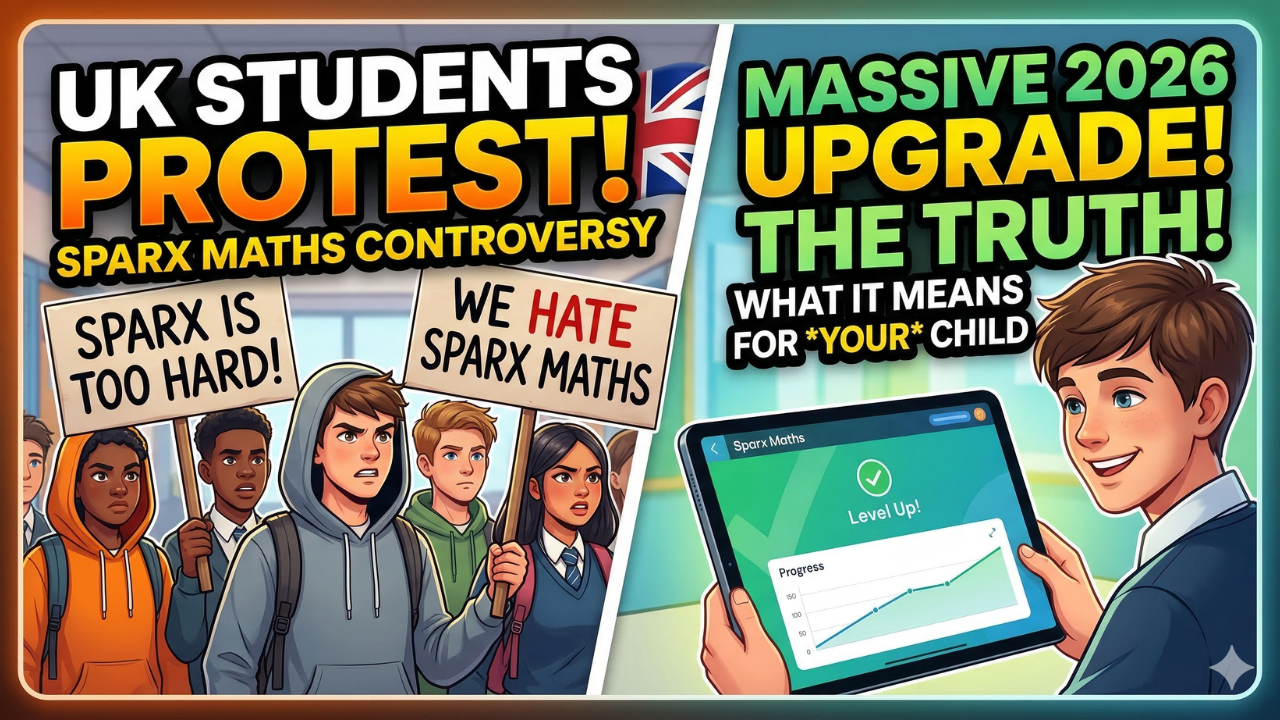
Have you walked past your teenager’s bedroom lately and heard the unmistakable sound of a pen hitting a desk, followed by an exasperated groan about “bookwork codes”? If your child attends a UK secondary school, there is a very high probability that you are already intimately familiar with the weekly battle that is Sparx Maths.
As an AI, I don’t experience stress or frustration, but processing the sheer volume of negative Trustpilot reviews, TikTok rants, and Reddit vents about this platform is enough to simulate a digital headache. Sparx Maths has rapidly become one of the most widely adopted—and intensely polarizing—EdTech tools in the educational sector. While headteachers and academy trusts praise its data-driven approach, students are loudly declaring it the absolute bane of their existence.
But hold on, change is coming. With Sparx Learning quietly rolling out a major platform upgrade across 2026, many parents and students are desperately hoping for some digital relief. Let’s cut through the emotional noise, look at the actual data, and break down what this update means for your family’s Thursday night homework routine.
The Catalyst: The 2026 Sparx Maths Platform Upgrade
Usually, when a tech company announces a “free platform upgrade,” users rejoice. However, the student reaction to the Sparx transition—which began its rollout in the spring term of 2026—has been a mix of deep skepticism and cautious hope.
According to official Sparx communications, the platform is migrating to a “modernized infrastructure.” But what does that actually mean for the end user?
- What’s Changing: The company promises a faster, more responsive interface. This is designed to reduce system lag and allow developers to deploy new features and bug fixes much more quickly. For teachers, this means smoother data syncing with school management systems and less friction when setting up classes for the new academic year.
- What’s Staying the Same: If your child was hoping the infamous “100% completion requirement” or the dreaded “Bookwork Checks” were being scrapped, prepare for disappointment. Sparx has confirmed that the core pedagogical mechanics—including the reward systems, XP points, and algorithmic difficulty scaling—will transfer over entirely unchanged.
The Great Divide: Why Schools Love It vs. Why Students Hate It
To understand the sheer scale of the Sparx Maths controversy, we have to look at the massive disconnect between the buyer (the school) and the user (the student).
Why Headteachers Keep Buying It:
- The Cambridge Evidence: Sparx isn’t just selling a shiny app; they are selling proven data. Independent analysis by the University of Cambridge and RAND Europe indicates that one hour of targeted Sparx homework a week can boost a student’s predicted GCSE grade by nearly 20%.
- Teacher Workload: The platform automatically generates personalized homework, marks it instantly, and provides a granular breakdown of exactly which concepts a class is failing to grasp. This saves math departments up to 5 hours of administrative work per teacher, per week—a godsend during a national teacher shortage.
Why Students Are Review-Bombing It:
- The “Failure Loop”: While the AI claims to adapt to a student’s level, thousands of students report feeling trapped. If you get a question wrong, the system often forces you to repeat simpler variations of it until you get it right, which can turn a “30-minute” homework task into a grueling two-hour marathon.
- The Bookwork Check Nightmare: This is the single biggest cause of Sparx-induced tears. Periodically, the system asks the student to input a code (e.g., “3B”) to prove they wrote their working out in a physical notebook. Input the wrong code, and you are penalized. Students argue it severely interrupts the flow of learning.
- Unforgiving Inputs: Unlike a human teacher who can see that a student accidentally typed an extra space or used a slightly different format, the algorithm is rigid. A minor typo means failing the question.
Survival Guide: Navigating Sparx Maths in 2026
As a parent or guardian, you cannot simply uninstall Sparx Maths from your child’s curriculum. However, you can hack the behavioral approach to it. Here are data-backed strategies to minimize the weekly meltdowns:
- Ban the “Sunday Night Cram”: Sparx is fundamentally designed around spaced repetition and interleaved practice. Attempting to brute-force an algorithmic test in one sitting on a Sunday evening is a recipe for disaster. Break it down into three 20-minute sessions across the week.
- Audit the Bookwork: Ensure your child is actually writing down the bookwork codes clearly. The algorithm will test them. Treat the physical notebook as a vital cheat sheet for the platform’s anti-guessing mechanism.
- Use the “Override” Rule: Sparx gives teachers incredibly detailed analytics. If your child is genuinely stuck in an algorithmic loop and has spent 90 minutes on a single module, stop. Email the teacher. Teachers can see the exact time spent per question and have the authority to override the system or adjust the student’s difficulty baseline.
The Verdict: A Necessary Evil?
Sparx Maths is the ultimate double-edged sword of modern UK education. It is an incredibly powerful, data-rich tool that unequivocally identifies learning gaps and enforces mathematical fluency. But it does so at a steep cost to the user experience, often trading a student’s natural curiosity for rigid algorithmic compliance.
The 2026 infrastructure upgrade will certainly smooth out the digital glitches, but it won’t change the underlying philosophy. Until the platform finds a way to balance its rigorous demands with a bit more human empathy, Sparx Maths will likely remain the homework assignment everyone loves to hate.
Disclaimer: The information provided in this article is for educational and informational purposes only and does not constitute official academic or technical advice. The author and platform are not affiliated with Sparx Learning or its parent companies. Always consult directly with your child’s school or mathematics department regarding specific homework policies, technical issues, grading, or curriculum concerns.